

Contents
A strategic roadmap preview (in development)
A medical representative’s day moves fast. Face-to-face appointments, last-minute cancellations, and constant pressure to make the most of the territory leave little time to sit down and interpret a dashboard. Yet expectations keep rising: sharper targeting, better conversations with HCPs, cleaner follow-up, and clearer proof of impact.
CRM systems have gotten good at recording what already happened. The harder problem, helping medical reps decide what to do next, largely remains unsolved.
That’s what Proxima is building toward.
Great data, slow decisions
Most pharma organizations have more data than ever. What they don’t always have is speed. Reps still spend time building plans manually, toggling between fragmented sources, and falling back on experience or habit when choosing the next call. Insights tend to arrive after the day is over, useful for reporting, but not for action.
For commercial leaders and SFE teams, this creates a familiar tension: activity is measurable, but improving field effectiveness is harder than it should be. When the field plan isn’t aligned with what’s happening across channels, the HCP experience becomes inconsistent and the business loses control of the engagement narrative.
The industry knows the direction it needs to move. In ZS’ “2025 AI trends” survey (base: 127 life sciences technology executives), 93% anticipated increasing investments in data, digital, and AI in 2025. McKinsey estimates gen AI could generate $18–$30B in annual value in pharma commercial functions alone. Deloitte also describes how commercial is being reshaped through end-to-end digital transformation across data, AI, and CRM ecosystems.
The investment is moving in the right direction. The question is whether it reaches the person standing outside a clinic with a tablet.
What level of AI are we actually talking about?
Not all AI assistants create the same kind of value. MIT CISR research across 721 companies identifies four maturity stages, with financial performance improving as maturity increases.
A practical way to think about “assistant value” in the field is by levels:
- Level 1: Reactive
The system responds to explicit requests: “show me the report,” “find this contact.” Many systems stop here. - Level 2: Informing
The system aggregates data and builds dashboards. The user sees the picture but still interprets it alone and decides what to do. - Level 3: Prescriptive
The system explains what is happening, why it matters, and suggests a specific next step. The user gets a recommendation with reasoning behind it. Decisions happen faster and with better inputs. This is the level Proxima is designing Smart Assistant for. - Level 4: Autonomous
The system acts without human involvement. In a pharma context, where each HCP interaction carries communication, ethical, and commercial responsibility, this is premature.
The choice of Level 3 is deliberate. Even as AI expands what’s possible, the human element remains central in pharma selling. As ZS notes, trust and credibility are not things technology can simply replace. What technology can do is help ensure the rep walks in better prepared, with clearer direction and less time spent reconstructing context from scratch.
What Smart Assistant is designed to do (in development)
Smart Assistant is planned as a decision support layer built directly into Proxima Cloud CRM. Not a separate tool. Not an additional screen. Intelligence embedded in the workflow where pharma sales reps already plan and execute.
It is designed to leverage the data commercial teams already generate: visit and engagement history, territory and frequency data, promotional activity, demand indicators, and, for clients using the GeoForce module, geospatial signals across the territory.
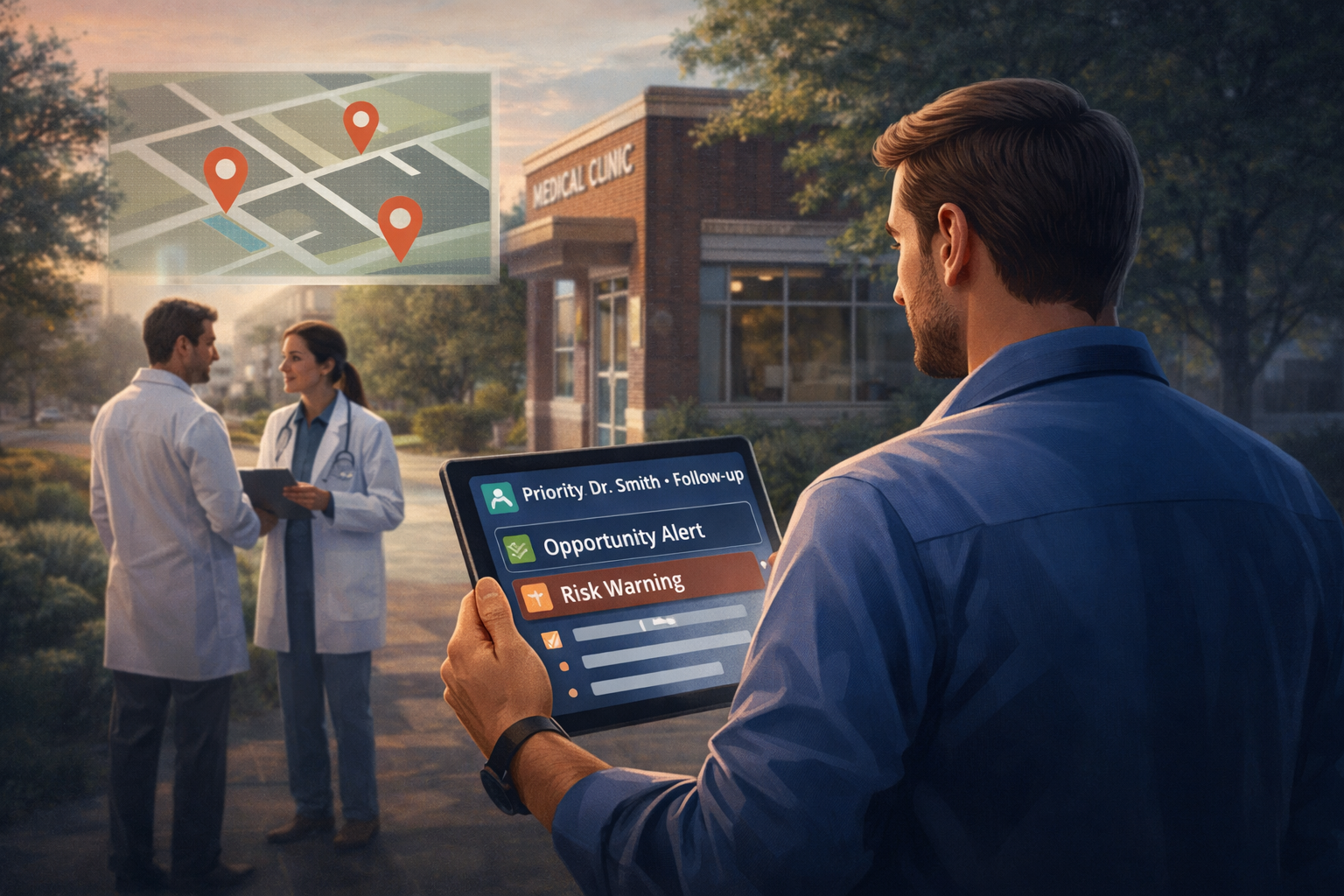
The output is not another analytics view. The goal is recommendations a rep can act on immediately:
- Which HCPs to prioritize this week, and why
- Suggested next steps to move each account forward: visit, follow-up, targeted engagement
- Early flags for risk: frequency slipping, responsiveness declining
- Early flags for opportunity: demand trending up, new engagement signals worth pursuing
Explainability is central to the design. Research on operationalizing next-best-action in pharma highlights that recommendations must be usable in real workflows, not just technically correct, or adoption drops and value never materializes.
What would changes in a rep’s day
A rep opens Proxima Cloud CRM in the morning. Smart Assistant surfaces a prioritized view of the week.
One account is highlighted: demand signals are trending up, but the last visit was three weeks ago and frequency is behind plan.
A second is flagged: a recent marketing touchpoint generated a response worth following up in person.
A third shows a risk pattern: visit cadence has been slipping and responsiveness is declining.
The rep adjusts the route, prepares a tighter message for the first visit, and schedules a follow-up task from inside the post-visit flow, before leaving the clinic or pharmacy.
No spreadsheet export. No end of day reconstruction from memory. Decision support and the activity record exist in the same place.
In practical terms, this shift is what it makes possible:
- Less time building a plan from scratch each morning
- Clearer call objectives before walking into the clinic
- Fewer missed follow-ups because the next step is captured at the right moment
- More consistent prioritization across the team, even in complex territories
Small decisions, made with better information, compound across a territory.
What leaders would gain
For field managers, the picture changes when reps operate with a shared decision logic rather than individual instinct. Coaching shifts from reconstructing what happened to focusing on quality and coverage. Patterns become visible earlier. You can intervene before a situation deteriorates, not after.
For commercial and SFE leadership, the long-term value is in what becomes measurable. When field execution follows a consistent logic, the relationship between specific actions (visit timing, follow-up rate, engagement cadence) and outcomes becomes legible in a way purely activity-based CRM usage does not support.
For CRM and IT teams, Smart Assistant is designed to live inside Proxima Cloud CRM, not alongside it. No parallel system. No separate adoption curve. Execution stays anchored to one consistent operational source of truth.
Traditional CRM vs. Smart Assistant
Traditional CRM reporting answers one question: What happened?
Smart Assistant is being built to answer a different one: What should we do next, and why?
That shift matters because the best guidance is useful while there is still time to influence an outcome, not after the week has already closed.
Be ready before others
Smart Assistant is on the Proxima product roadmap as the next step in the evolution of Proxima Cloud CRM.
Here is what matters right now: the value of an AI assistant is not determined only by the quality of the algorithm. It is determined by the quality of the data and processes the algorithm runs on. Structured engagement history, consistent territory data, disciplined planning, and follow-up habits are built over time, not switched on overnight.
Organizations that start working with Proxima Cloud CRM today are building the operational foundation that will make the transition to prescriptive AI faster and more effective when Smart Assistant becomes available.
If you are evaluating a CRM for pharma field teams and want early details on the Smart Assistant roadmap direction, we would like to show you what Proxima Cloud CRM looks like today. Contact us to schedule a demo and receive updates.
References
- ZS Associates. 2025 AI trends: Life sciences leaders on data, digital and AI. Nov 20, 2024.
- McKinsey & Company. Generative AI in the pharmaceutical industry: Moving from hype to reality. Jan 9, 2024.
- McKinsey & Company. Early adoption of generative AI in commercial life sciences. May 6, 2024.
- Deloitte. End-to-end transformation of pharma’s commercial activities. Oct 10, 2024.
- Weill, P., Woerner, S.L., Sebastian, I.M. MIT CISR. Building Enterprise AI Maturity. Dec 19, 2024.
- Cohen, M-D., Baer, A., Steiner, M. An Approach to Operationalizing Next Best Action in Pharmaceutical Communications and Marketing. Journal of PMSA, Spring 2019.
- ZS Associates. The value of pharma sales reps in the AI era. Mar 3, 2025.